
The 8 Types of Laptop Cafe Spots Every Freelancer, Remote Worker and Student Should Know
Whether you work from home, study between classes, or just need a change of pace to open your laptop and get to work, finding the right cafe can make — or break — your day. Not all cafes are equal. Some are loud and crowded. Others have awful Wi-Fi or nowhere to plug in your charger.
In this laptop cafe guide, we examine 8 different kinds of cafe spots that freelancers, remote workers and students should know about. By the end, you’ll know precisely what to look for — and what to avoid — so that every session is productive.
Why It Actually Matters
You may think that any cafe with Wi-Fi is good enough. But ask any remote worker and they’ll tell you otherwise.
The wrong environment kills focus. A bad connection is time wasted. Without a power outlet, you watch your battery tick down while scrambling to meet a deadline.
The right cafe, on the other hand, is your second office. It enhances creativity, helps keep you in the zone, and saves money compared to renting a co-working space.
So here are the 8 kinds of places you need to know.
1. Specialty Coffee Shops — The Old Reliable
This is exactly what most people picture when they imagine working from a cafe. Specialty coffee shops are independent cafes that specialize in premium espresso drinks, pour-overs and single-origin beans.

These places attract a specific type of crowd — creative professionals, freelancers, writers and students. That often means the mood is just right for getting work done on a laptop.
What Makes Them Great
The vibe is calm but alive. There’s ambient noise — light chatter, soft music, the hiss of the espresso machine — which many people say helps them focus. Research even backs this up: moderate ambient noise can enhance creative thinking.
Most specialty shops also have decent Wi-Fi, a smattering of power outlets and comfortable seating that makes you want to linger.
What to Watch Out For
These places fill up quickly during morning rush hours. Before 9 AM and between noon and 1 PM on weekdays, it can be standing room only. Don’t count on finding a corner seat with an outlet at those times.
Pro tip: Visit between 9:30 and 11:30 AM on a weekday. That’s the sweet spot when the morning rush has cleared and the lunch crowd hasn’t arrived yet.
Also, most specialty shops have an unspoken rule — buy something every few hours. Nursing a water all day with your laptop open won’t win you any fans.
2. Co-Working Cafes — The Best of Both Worlds
This is a newer category, and it’s a big growth area. A co-working cafe is exactly what it sounds like — part cafe, part co-working space.
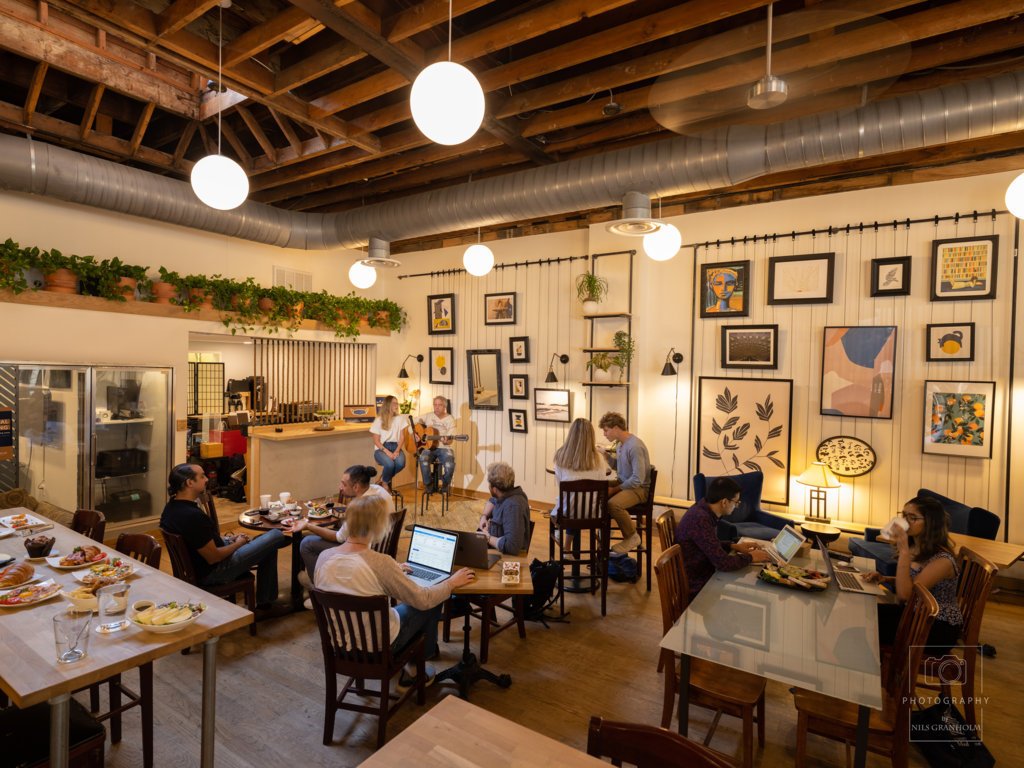
You pay a daily fee (often $10–$25) or sign up for a monthly membership. In exchange, you get fast, dedicated Wi-Fi, a proper desk or workstation, ample outlets and coffee or tea included.
Why Remote Workers Love Them
It’s the most purpose-built option in this entire guide. Everything is organized around laptop workers. The Wi-Fi is business-grade. The furniture is ergonomic. And there are usually private booths or phone call corners for when you need to take a meeting.
Many co-working cafes are also quieter than a regular coffee shop. The crowd are workers, not people hanging out — and that matters more than most people realize.
The Downside
Cost is the biggest barrier. If you’re a student or on a tight budget, spending $20 per day adds up quickly. Monthly memberships make more sense if you plan to use the space regularly.
Look for co-working cafes that offer trial days or first-visit discounts. Many do.
3. Library Cafes — The Underrated Hidden Gem
Here’s one most people overlook. Public libraries and university libraries commonly have in-house cafes today — usually small counters offering coffee, tea, sandwiches and snacks, right inside the building.
Why You Should Keep This in Mind
The environment is hard to beat. Libraries are designed for quiet and concentration. You get the café beverage without the café decibel level. The library has strong Wi-Fi throughout, and there’s no charge to sit down.
This is a big win, especially for students. You’re already near physical reference materials, printing services and study rooms.
Things to Keep in Mind
Library cafes usually keep early hours, often closing by 5 or 6 PM. They can also get busy around exam periods. And not every library has a proper cafe — some only have vending machines.
Check online or call ahead before making it your regular spot. But if your local library has one, it should be high on your list.
4. Hotel Lobby Cafes — The Secret Power Move
This one surprises people. Hotel lobbies — particularly those attached to business-oriented hotels — are remarkable places to work. The little secret is that you don’t even have to be a hotel guest. Just walk in, order a drink, and you’re set.
The Big Advantages
Business hotels invest heavily in great Wi-Fi. It’s fast, consistent and dependable — business travelers need it for video calls and uploading large files.
The atmosphere is professional and calm. Plush chairs, proper tables, frequent outlets and staff trained not to crowd you. For a client call or video meeting, a hotel lobby cafe will not let you down.
Cost and Etiquette
A coffee might run you $5–$8. That is, for all practical purposes, the cost of working there.
Dress reasonably. You don’t need to wear a suit, but dressing as if you belong there goes a long way toward being treated like a hotel guest.
5. Bookstore Cafes — Calm, Creative, Comfortable
Giant bookstore chains and small independent bookshops with cafe areas offer something you can’t get elsewhere — a sense of place.
The ambiance is intellectual and quietly inspiring, subtly motivating you to do your best work. Something about being surrounded by books and people who are reading makes you want to focus.
What Sets Them Apart
They’re quiet. Not hushed, but calmer than most cafes — thanks to the nature of the space and the kind of people it attracts.
These places typically offer decent Wi-Fi, affordable prices and plenty of seating to carve out a little nook. Background music, when present, tends to be low and unobtrusive.
Limitations
Older bookstore setups can limit your access to outlets. Wi-Fi can also be patchy if the bookstore hasn’t updated its network infrastructure in a while.
When you first arrive, test the connection. If it’s slow, treat it as a solid spot for offline work — writing, planning, editing — where speed isn’t essential.
6. Food Court Cafes — Chaotic but Surprisingly Useful
This one isn’t for everyone. But if you’re open to flexible and adaptive conditions, a food court inside a shopping mall or transit hub can actually work.
Most food courts include a coffee or tea counter. Find a nearby seat with an outlet, grab your drink and you have a workspace.
When This Makes Sense
Food courts shine when flexibility is your priority. They’re open long hours. There’s plenty of food to grab without leaving your working zone. They’re air-conditioned in summer and heated in winter.
In major cities, some transit hubs and airports also offer surprisingly good Wi-Fi.
The Reality Check
Food courts are loud. Full stop. If you need to do deep focus work — complex coding, detailed writing, creative brainstorming — this is not your spot.
But for administrative tasks, answering emails or anything that doesn’t require silence? It works fine. Noise-canceling headphones are your best ally here.
7. Outdoor Garden Cafes — Fresh Air and Getting Down to Business
More cafes are adding outdoor seating — patios, rooftop decks, garden courtyards. On the right day, these become ideal laptop workspaces.
The Case for Working Outside
Fresh air genuinely helps with alertness and mood. Natural light is less straining on the eyes than fluorescent indoor lighting. And there’s a mental shift that happens when you take your work outside — it can break through creative blockages that indoor environments reinforce.
Some outdoor spaces are specifically designed for remote workers, with weatherproof power outlets built into table structures, covered seating for light rain and even Wi-Fi extenders so the internet reaches outdoors.
The Challenges
Weather is the obvious one. On bright days, sun glare on your screen is a real issue. Wind interferes with papers and audio.
Lowering your screen brightness helps conserve battery life. If you work outdoors often, consider an anti-glare screen protector. And always check the forecast.
Ideal timing: Late morning on spring or fall days — not too hot, and the sun isn’t directly overhead.
8. 24-Hour Cafes — For Night Owls and Deadline Warriors
The final entry in this guide is for a particular kind of worker — the kind who hits their stride around 11 PM.
24-hour cafes, found near universities, hospitals and busy urban areas, stay open around the clock. For people who keep irregular hours — freelancers working across time zones, students cramming for finals, writers whose creative peak hits at midnight — these places are a lifeline.
What Makes Them Unique
You never have to race against closing time. Late at night, these spots tend to be quieter, less crowded and offer more available seats and outlets.
Many 24-hour locations are chains — larger coffee brands in busy urban areas — or independently owned late-night diner-style cafes.
Things to Be Aware Of
Wi-Fi quality can vary. Some 24-hour establishments throttle their bandwidth late at night or run on older routers. Coffee quality may not be up to specialty standard. And safety matters — stick to well-lit, high-traffic locations.
Bring your charger. These spots attract people doing exactly what you’re doing, and competition for outlets can get real after midnight.
What to Check Before You Set Up at Any Cafe
Whatever type of laptop cafe you go for, run through these quick checks when you arrive.
| What to Check | What to Look For |
|---|---|
| Wi-Fi speed | Use a speed test app. 10 Mbps download is the minimum workable. For video calls, target 25+ Mbps. A reliable tool for this is Speedtest by Ookla |
| Outlets | Scan the room before you sit. A dead battery in a cafe with no outlets isn’t a workspace — it’s just a coffee shop |
| Noise level | Give it 3 minutes of honest listening. Is it tolerable? Can you concentrate? Trust your gut |
| Seating comfort | If you’re sitting for 2–3 hours, a hard wooden stool is going to become a problem. Choose a spot where you can actually get work done |
| Order expectations | Some cafes require a minimum spend. Some expect you to reorder every couple of hours. Know the vibe before you wear out your welcome |
Quick Tips to Maximize Any Laptop Cafe
A few habits separate people who thrive in cafe workspaces from those who struggle.
Keep a personal hotspot as backup. Even the best cafe Wi-Fi can be choppy. That’s when a mobile hotspot on your phone comes to the rescue.
Arrive early at popular spots. The best tables — corner booths, window seats near outlets — go quickly. Beat the crowd by 20 minutes.
Use headphones. Noise-canceling headphones are the single best investment you can make for laptop cafe work. They improve the experience at every type of spot on this list.
Be a good customer. If you’re there a while, buy something every hour or two. Leave a tip when you can. Treat the staff with respect. Being a “regular” at a good spot has real benefits — the best table is often waiting for you without you even having to ask.
Keep your gear secure. Be mindful of your belongings in public places. If you step away, use a laptop lock cable. Keep your bag close.
FAQs — Laptop Cafe Guide
Q: Is it awkward to work on a laptop at a cafe for hours? It depends on the specific cafe and how busy it is. At low-traffic hours, most cafes welcome you to stick around. During the lunch rush, tying up a table for four hours over a single coffee is bad manners. Buy something, tip generously and read the room.
Q: What Wi-Fi speed is good enough to work from a cafe comfortably? 5–10 Mbps is sufficient for basic tasks like checking email or editing documents. For video calls, you’ll want 25 Mbps or faster. For uploading or downloading large files, aim for 50+ Mbps. Always run a quick speed test when you arrive.
Q: Are hotel lobby cafes really open to the public? Yes, in almost all cases. Anyone can use a hotel lobby cafe. Just order a drink at the bar or cafe counter and take a seat. You do not have to be a guest at the hotel.
Q: What is the ideal type of cafe for video meetings? Co-working cafes and hotel lobby cafes are the best options for video calls. They provide the fastest, most stable Wi-Fi, lower noise levels and often have dedicated phone or meeting booths. Specialty coffee shops can work, but background noise can be a distraction when things get busy.
Q: Is it acceptable to work from a cafe without purchasing anything? Cafes can’t technically enforce a minimum purchase. But it’s bad practice. The cafe is a business, and if you’re using their space and Wi-Fi for hours — buying a drink is simply the right thing to do. Think of it as a very cheap membership fee for your workspace.
Q: What kind of cafe from this guide is best for students? Library cafes are almost always the winner for students. They’re quiet, cheap or even free, and the study-oriented vibe keeps you productive. When you need something warmer and more social, specialty coffee shops are a close second.
Q: Is outdoor cafe Wi-Fi typically reliable? It varies widely. Many outdoor cafe setups have solid extended Wi-Fi coverage. Others drop signal the moment you step outside. Always check the connection before committing to an outdoor table for serious work. And keep a cell data backup handy.
Final Thoughts — How to Find Your Perfect Work Cafe
There’s no single “best” spot. Certain cafes work for certain kinds of tasks, times of day and types of people.
The specialty coffee shop is where creative flow happens. For sheer productivity, the co-working cafe leads the pack. The library cafe wins on focus and budget. The hotel lobby is where you turn when professionalism counts. The bookstore cultivates a steady, creative atmosphere. The food court is the wildcard for flexible workers. The outdoor garden cafe clears your head when walls start to feel confining. And late at night, when the rest of the world is asleep, there’s the 24-hour cafe.
Use this guide to figure out which types align with the way you work. Then find the specific spots in your city that meet those criteria. Once you find your places, you won’t know how you ever worked without them.